An EMT jump bag is a portable inventory of decisions made in advance. When a crew arrives on scene, there is no time to wish a tourniquet had been packed or that the oxygen tank had been checked. The bag has to already hold the right items, in the right sizes, in working order. That is why a contents checklist organized by clinical function, rather than a random pile of supplies, is the foundation of a reliable response.
This checklist is organized the way care actually unfolds: airway, breathing, circulation and bleeding control, assessment and monitoring, immobilization, medications within scope, and protection and documentation. It explains what belongs in a basic life support bag, where advanced life support adds to it, and how a provider's licensure level governs what can be carried and used. It is written for EMS agencies, fire departments, industrial and event medical teams, and clinics that keep a first-response bag on hand.
First, Match the Bag to Your Scope of Practice
What you can carry and use is defined by licensure level before it is defined by preference. The National EMS Scope of Practice Model, published by NHTSA, describes four levels: Emergency Medical Responder (EMR), Emergency Medical Technician (EMT), Advanced EMT (AEMT), and Paramedic. The model is national guidance; the rules that bind you are your state's EMS regulations and your medical director's protocols, which can be narrower.
The short version, summarized in the StatPearls overview of EMS scope of practice: EMTs deliver basic life support, including airway adjuncts, oxygen, bleeding control, and basic assessment. AEMTs add limited advanced skills and some pharmacology. Paramedics add advanced airway management, manual defibrillation, intravenous and intraosseous access, and a broad medication set. The 2021 change notices to the model also added intramuscular injection at the EMT level, immunizations during a declared public health emergency across EMT, AEMT, and paramedic levels, and nasal swab specimen collection. Stock the bag to your level and your protocols, not above them.
Airway and Breathing
Airway is first because an obstructed or unprotected airway is fatal fastest. A basic bag should carry the adjuncts and ventilation tools an EMT is trained to use.
- Oropharyngeal airways (OPAs) in a full size range, for unconscious patients without a gag reflex.
- Nasopharyngeal airways (NPAs) in a size range, with water-soluble lubricant.
- Bag-valve-mask (BVM) in adult and pediatric sizes, with assorted mask sizes and an oxygen reservoir.
- Suction. A portable suction unit with rigid (Yankauer) and flexible catheters to clear blood, vomit, and secretions. See our portable suction machine buying guide for the specs that matter in the field.
- Oxygen. A portable cylinder with a regulator, plus nasal cannulas and non-rebreather masks in adult and pediatric sizes. Our overview of oxygen delivery device types covers when each is used.
- Pulse oximeter to guide oxygen therapy.
An AEMT or paramedic bag extends this section with supraglottic airways such as an i-gel or King LT, and a paramedic bag adds endotracheal intubation supplies, a laryngoscope or video laryngoscope, end-tidal carbon dioxide monitoring, and a means of needle decompression. These advanced airway items belong only in bags carried by providers licensed to use them.
Circulation and Bleeding Control
Uncontrolled external hemorrhage can kill within minutes, and bleeding control is squarely within EMT scope. The American College of Surgeons Stop the Bleed program teaches three actions for life-threatening bleeding: firm direct pressure, wound packing with gauze, and a tourniquet for extremity bleeding that does not stop. Stock the bag to perform all three.
- Tourniquets. Carry at least two windlass-style tourniquets. Multiple-casualty scenes and bilateral injuries can require more than one at a time.
- Hemostatic gauze for wound packing in junctional areas where a tourniquet cannot be applied.
- Trauma dressings and pressure bandages in several sizes.
- Chest seals for penetrating chest wounds.
- Trauma shears to expose wounds quickly.
- Gauze rolls, abdominal pads, and tape for general wound care.
A standard bleeding control kit, as defined by the Stop the Bleed program, contains a windlass tourniquet, compressed gauze, a pressure dressing, shears, gloves, and a marker. Building those items into the jump bag, rather than relying on a separate kit that may be left in the rig, keeps hemorrhage control on the responder.
Assessment and Monitoring
You cannot treat what you have not measured. The assessment section turns a responder into a clinician with a baseline and a trend.
- Blood pressure cuffs in adult, large adult, and pediatric sizes, with a quality stethoscope.
- Pulse oximeter (also listed under breathing, since it serves both).
- Glucometer with test strips and lancets, for altered mental status.
- Thermometer.
- Penlight for pupillary assessment.
- Trauma and assessment documentation such as a patient care report form or device.
Advanced bags add a cardiac monitor and manual defibrillator at the paramedic level, while EMT-level bags pair with an automated external defibrillator (AED) carried alongside the kit. Several of these tools, including blood pressure cuffs, pulse oximeters, glucometers, and laryngoscopes, are durable instruments where a professionally inspected refurbished unit can lower cost without sacrificing function, which we discuss in the sourcing section below.
Immobilization and Splinting
Stabilizing injuries prevents further harm during movement and transport.
- Cervical collars in an adjustable or multi-size set.
- Splints, including rigid, padded, and traction options for long-bone and angulated fractures.
- Triangular bandages for slings and swathes.
- Elastic (self-adherent) wraps to secure splints and dressings.
The depth of immobilization gear in the jump bag varies by agency, since backboards, scoop stretchers, and vacuum splints usually live in the ambulance rather than the bag. The bag should carry what a crew needs at the patient's side before the stretcher arrives.
Medications Within Scope
Medication stock is the most scope-dependent and protocol-dependent section, so treat the following as categories to confirm against your own formulary, not a universal list. At the EMT level, common medications a provider may assist with or administer under protocol include oxygen, oral glucose, aspirin for suspected cardiac chest pain, an epinephrine auto-injector for anaphylaxis, and naloxone for suspected opioid overdose; some systems add inhaled bronchodilators. AEMT and paramedic bags carry progressively broader formularies with intravenous medications.
Because the 2021 scope model added intramuscular injection at the EMT level, some agencies expand what their EMTs administer; always verify against your state rules and medical direction. Keep medications within their temperature range, track expiration dates, and rotate stock so nothing in the bag is expired when it is needed.
Protection, Hygiene, and the Bag Itself
Personal protective equipment and a few practical extras round out a complete bag.
- Exam gloves in multiple sizes, ideally nitrile, in quantity.
- Eye protection and masks, plus gowns for higher-exposure calls.
- Hand sanitizer and disinfectant wipes.
- Sharps container for any bag carrying needles.
- Biohazard bags for contaminated waste.
- Trauma shears, flashlight, spare batteries, pen, and a pad.
- Emergency blanket for warmth and shock management.
The bag itself is equipment. Choose a layout with color-coded or labeled compartments so any crew member can find an item under stress, and standardize the layout across every bag in the fleet so muscle memory transfers from one unit to the next.
| Category | Core BLS items | ALS additions (AEMT / Paramedic) |
|---|---|---|
| Airway and breathing | OPAs, NPAs, BVM, suction, oxygen, pulse oximeter | Supraglottic airways, intubation kit, ETCO2, needle decompression |
| Circulation / bleeding | Tourniquets, hemostatic gauze, dressings, chest seals, shears | IV/IO access supplies, fluids |
| Assessment | BP cuffs, stethoscope, glucometer, thermometer, penlight | Cardiac monitor, manual defibrillator |
| Immobilization | C-collars, splints, triangular bandages, wraps | Same, agency dependent |
| Medications | Oxygen, oral glucose, aspirin, epinephrine, naloxone | Broader IV formulary per protocol |
Restocking and Sourcing the Bag
A jump bag is only as ready as its last restock. Two habits keep it reliable, and one sourcing decision keeps it affordable.
First, run a checklist audit after every call and on a fixed schedule, verifying quantities, sizes, expiration dates, oxygen tank pressure, and battery charge. Many agencies seal restocked bags with a numbered tag so a broken seal signals the bag needs re-checking. Second, separate the consumables budget from the equipment budget. Disposables such as gloves, gauze, dressings, OPAs, and oxygen tubing are bought new and bought often, while durable instruments are bought rarely.
That durable category is where sourcing matters. Blood pressure cuffs, stethoscopes, pulse oximeters, glucometers, laryngoscopes, and portable suction units are mechanically straightforward and long-lived, which makes a professionally inspected refurbished unit a practical way to outfit multiple bags or vehicles at lower cost. The same verification logic that applies to any used clinical device applies here: confirm function, batteries, calibration where relevant, and a warranty. For a single emergency-response perspective on the larger kit these bags support, our crash cart checklist covers the fixed-station counterpart to the mobile jump bag.
Frequently Asked Questions
What should be in a basic EMT jump bag?
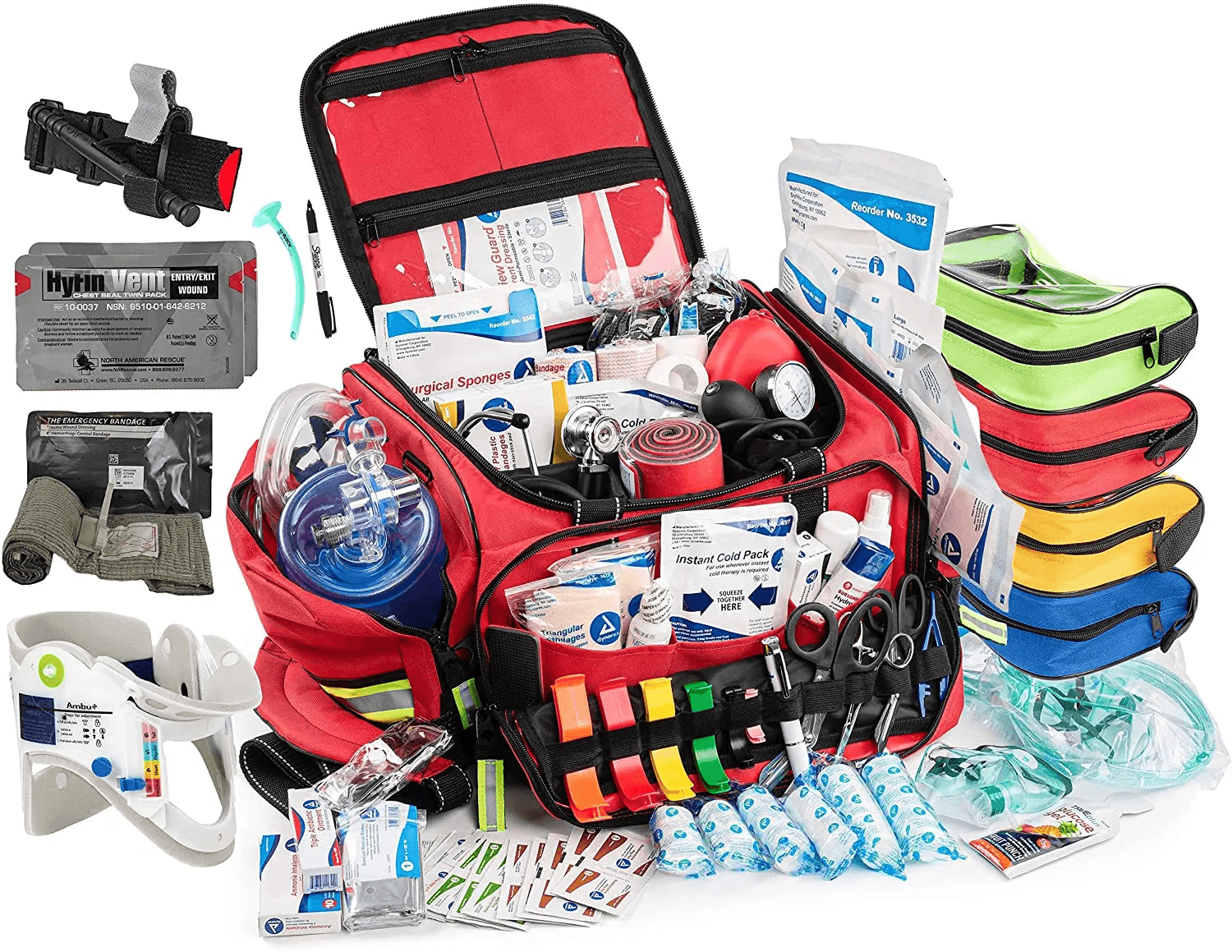
A basic life support jump bag should cover airway and breathing (OPAs, NPAs, a bag-valve-mask, suction, oxygen, and a pulse oximeter), bleeding control (at least two tourniquets, hemostatic gauze, dressings, chest seals, and shears), assessment tools (blood pressure cuffs, a stethoscope, a glucometer, and a thermometer), immobilization (cervical collars and splints), scope-appropriate medications, and personal protective equipment. Organize it by clinical function so items are found fast under stress.
What is the difference between a BLS and an ALS jump bag?
A basic life support (BLS) bag carries airway adjuncts, oxygen, bleeding control, basic assessment tools, and a short list of medications an EMT may use under protocol. An advanced life support (ALS) bag adds the interventions AEMTs and paramedics are licensed for: supraglottic and endotracheal airways, intravenous and intraosseous access, a cardiac monitor and manual defibrillator, and a broader medication formulary. The dividing line is the provider's licensure level and local protocols.
How many tourniquets should an EMT bag carry?
Carry at least two windlass-style tourniquets. A single patient can have more than one bleeding extremity, and multiple-casualty incidents can demand several at once. Tourniquets are inexpensive relative to the bleeding they control, so redundancy is sensible.
Does scope of practice affect what goes in the bag?
Yes. The National EMS Scope of Practice Model defines what EMRs, EMTs, AEMTs, and paramedics may do, and your state EMS regulations and medical director's protocols set the binding limits, which can be narrower than the national model. Stock and use only what your licensure level and protocols authorize. The 2021 model added intramuscular injection at the EMT level, among other changes.
How often should a jump bag be checked and restocked?
Audit the bag after every call and on a fixed schedule, verifying quantities, sizes, expiration dates, oxygen tank pressure, and battery charge. Many agencies seal a restocked bag with a numbered tag so a broken seal flags a bag that needs re-checking. Buy disposables new and often; durable instruments can be sourced new or as inspected refurbished units to control cost.