It looks like a trivial plastic paddle, so most buyers grab the cheapest one. But a solid cover and a pinhole answer two different clinical questions, and an occluder that does only one of them, or that lets the patient peek, can quietly invalidate the test you bought it for.
An eye occluder is a handheld device that blocks vision in one eye during an eye examination. To be clear about which device this guide covers: this is the ophthalmic vision-testing occluder used by optometrists, ophthalmologists, orthoptists, and screening programs, not the cardiac septal or PFO occluder, which is an unrelated implant. The ophthalmic version is, as the reference on the pinhole occluder describes, an opaque disk with one or more small holes, used to test visual acuity. That one sentence already contains the buying decision: the solid part of the disk and the pinhole do two separate jobs, and not every occluder does both well. This guide is vendor-neutral. It covers the two jobs, the pinhole test and what it rules in or out, single versus multiple pinholes, the form factors, cleaning between patients, what these cost, and how to choose by setting.
What an eye occluder is, and the two jobs it does
Visual acuity is measured one eye at a time. A standard acuity test is read at 20 feet, or 6 meters, and each eye is tested individually as well as together, as the StatPearls reference on the Snellen chart notes. To test one eye, you have to reliably block the other. That is the occluder's first and most common job: solid occlusion.
Job one is solid occlusion. The opaque face of the occluder covers one eye completely so the patient reads the chart with the other. The only real requirement here is that it actually blocks vision, which is why opacity matters more than people expect. A translucent or thin occluder lets the covered eye contribute, and the result is a falsely good reading. In a vision screening, that can mean a child with one weak eye passes when they should have been referred.
Job two is the pinhole test. The same device, used through its small central hole instead of its solid face, becomes a quick diagnostic. The patient reads the chart through the pinhole, and whether the line gets sharper tells you something specific about why vision was blurry. This is the job the cheapest single-piece paddle without a hole simply cannot do, and it is the reason a clinician would pay more than a few dollars for the right occluder.
Before comparing products, decide which jobs you need. The table below is the short version.
| If you need to | Buy | Why |
|---|---|---|
| Cover one eye for acuity only | Solid handheld occluder | Opaque face, easy to hold, easy to clean |
| Cover one eye and run pinhole checks | Occluder with a single pinhole | Does both jobs in one device |
| Screen quickly, including less cooperative patients | Multiple-pinhole occluder | Easier for the patient to find a clear hole |
| Screen at high volume with infection control | Single-use disposable occluders | No cleaning between faces, low unit cost |
| Occlude on a trial frame during refraction | Flip or clip occluder for the frame | Frees both hands at the phoropter or trial frame |
The pinhole test: refractive error versus everything else
The pinhole is the feature that makes an occluder a diagnostic tool rather than a blindfold, so it is worth understanding what it actually tells you.
Light entering the eye through only a small central hole bypasses most of the cornea and lens, which removes the effect of a focusing error. So if blurry vision is caused by a refractive error such as nearsightedness, farsightedness, or astigmatism, acuity improves through the pinhole. The StatPearls reference on the evaluation of visual acuity states the rule directly: an improvement in visual acuity with the pinhole over the unaided value indicates the presence of a refractive error. In practice, that is the quickest way to tell whether a patient simply needs glasses.
The more useful half of the result is what happens when vision does not improve. If the pinhole produces no improvement, the cause is usually not refractive. That points toward the media or the back of the eye, for example a cataract clouding the lens, or a retinal or optic-nerve problem. This is the honest answer to a question people search for: the pinhole is a screening clue for macular and retinal disease only in the sense that those conditions typically fail to improve through the pinhole, unlike a refractive blur. The pinhole does not diagnose macular degeneration. It separates the can-be-fixed-with-glasses case from the needs-a-closer-look case, and the second group is where it earns its keep.
This is also why a translucent occluder is a problem on the pinhole side as well as the solid side. If stray light leaks around the aperture, the pinhole effect is diluted and a borderline result becomes ambiguous. Opacity is not a luxury feature on an occluder. It is what makes both jobs valid.
Single pinhole versus multiple pinholes
Once you know you want a pinhole, the next fork is how many. This is a genuine purchase decision, not a cosmetic one.
A single pinhole is the classic clinical aperture. The hole is small, on the order of about 1 millimeter, which is the size range the StatPearls reference on low vision aids cites for clinical pinholes. A hole that small is what produces a clean result, but it also demands that the patient line their pupil up behind it, which some patients, especially children or anyone with poor fixation, find fiddly.
A multiple-pinhole occluder drills a small array of holes instead of one. The patient is more likely to have a clear aperture in front of the pupil without precise alignment, which makes it faster and more forgiving in screening or with less cooperative patients. The tradeoff is that a multi-hole array can be slightly less precise than a single well-aligned pinhole for a careful refraction check. A reasonable rule: single pinhole for a deliberate clinical refraction lane, multiple pinholes where speed and patient cooperation matter more.
You will also see occluders bundled with extras, such as a Maddox rod, a red filter, or colored lenses, for muscle-balance and binocular testing. Those are useful in an orthoptic or full ophthalmic workup, but they are not part of basic acuity and pinhole screening. Buy the combo only if your testing actually calls for those functions. For most acuity and pinhole work, a plain occluder with one or several pinholes is the whole job.
Form factors, and the opacity that makes them work
Occluders come in a handful of shapes, and the right one depends on who holds it and how often it is used.
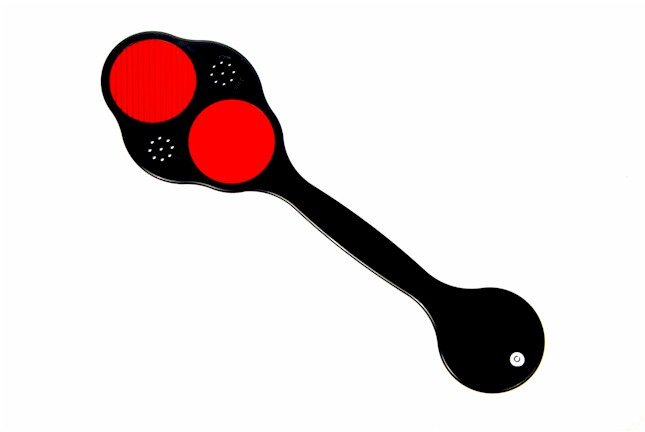
Handheld paddle or spoon. The standard reusable occluder, usually opaque black plastic, sometimes with a pinhole on one side. It is cheap, durable, and easy to wipe. The opaque body is the spec that matters: hold it up to a light and confirm you cannot see through it.
Occluder with built-in pinhole. The same paddle with a single pinhole or a pinhole array on one face, so one device covers both jobs. For most practices this is the sensible default.
Flip or clip occluder for trial frames. A small occluder that mounts on a trial frame or sits in the phoropter, so the examiner does not have to hold anything. This frees both hands during refraction. If your lane already uses a phoropter or trial frame, built-in occlusion may already be part of that workflow.
Occluder glasses and patches. Frames with a flip-down opaque panel, or simple adhesive eye patches, used mostly for repeated or hands-free occlusion. Note that a patch worn for testing is a different thing from a patch worn as amblyopia treatment, which is covered below.
Disposable single-use occluders. Thin opaque cards or paddles meant to be used once and discarded. They trade durability for infection control and are aimed at high-volume screening. More on why that matters in the next section.
Across all of these, opacity is the through-line. A translucent occluder, whatever its shape, undermines both the acuity test and the pinhole test, so check it before you check anything else.
Cleaning and infection control, the part the listings skip
This is the dimension no product page and no encyclopedia entry addresses, and it is where a buyer should spend a minute of thought. An occluder is held against the face, around the eye, patient after patient. That makes reprocessing, not bristle count or color, the real reusable-versus-disposable question.
Under the long-standing framework that healthcare facilities use, an item that contacts intact skin but not mucous membranes is a noncritical item, and noncritical items require only low-level disinfection, as the CDC explains in its guidance on a rational approach to disinfection and sterilization. The same CDC guidance lists everyday noncritical patient-care items such as blood pressure cuffs and bedpans, and a reusable occluder belongs in that category. In practice that means a reusable occluder should be a smooth, nonporous surface you can wipe down with an EPA-registered low-level disinfectant between patients, following the product's label contact time.
Two buying implications follow. First, choose a reusable occluder made of solid, wipeable plastic with no fabric, foam, or crevices that trap residue, because a device you cannot clean reliably should not touch the next patient's face. Second, for high-volume settings such as school screenings or busy clinics, single-use disposable occluders sidestep the reprocessing question entirely by being discarded after one patient. The decision is a tradeoff between the per-use cost of disposables and the labor and consistency of wiping down a reusable between each face.
What eye occluders cost
Prices are modest, which is exactly why buyers default to the cheapest option and sometimes buy the wrong tool. Rough ranges help frame the decision rather than the price tag.
A basic reusable handheld occluder is inexpensive, typically a few dollars, and an occluder with a built-in pinhole is only slightly more. Multiple-pinhole and combination occluders that add a Maddox rod, red filter, or colored lenses cost more because of the added optics. Disposable occluders are sold in bulk and are pennies to a few cents each, with the real cost being volume rather than unit price. Occluder glasses and trial-frame mounted occluders sit at the higher end of this small range.
The practical point is that the price spread across all of these is small enough that it should never drive the decision. Buying a single-hole occluder when you needed multiple pinholes, or a porous one you cannot clean, costs far more in redone tests and infection-control risk than the few dollars saved. Match the device to the job first, then compare prices within that category.
How to choose by setting
The same logic lands differently depending on where the occluder is used.
School and community vision screening. High volume, many faces, often less cooperative patients. This favors multiple-pinhole occluders for forgiveness and single-use disposables for infection control. The goal is a fast, valid pass or refer decision, and an opaque occluder that prevents peeking is what keeps the screening honest.
Optometry refraction lane. Here the occluder supports careful acuity and a quick pinhole check before or during refraction. A reusable occluder with a single pinhole is usually enough, and trial-frame or phoropter-based occlusion fits the workflow. The occluder works alongside the rest of the refraction toolkit, including the retinoscope and phoropter.
Ophthalmology and orthoptics. A fuller workup may call for the combination occluders with a Maddox rod, red filter, or colored lenses for binocular and muscle-balance testing. This is where the extras are worth buying, because the testing actually uses them.
Pediatrics and amblyopia. An important distinction lives here. The occluder used to test a child's eyes is not the same as the patch used to treat amblyopia. The standard treatment for amblyopia is patching the stronger eye to make the weaker eye work, as the National Eye Institute describes in its overview of amblyopia, or lazy eye. A testing occluder is a brief, in-office device. A treatment patch is a prescribed, worn-over-hours therapy. Do not buy a testing occluder expecting it to serve as amblyopia treatment, or the reverse.
For a wider view of what a vision-testing room needs, the optometry equipment guide and the ophthalmology equipment list set the occluder in context alongside charts, tonometers, and lights.
Pre-purchase checklist
Before you order, confirm the device against the job. A quick run through these points prevents the common mistakes.
- Opacity. Fully opaque, confirmed against a light. This protects both the acuity test and the pinhole test.
- Pinhole or not. If you need the refractive-versus-pathology check, the occluder must have at least one pinhole.
- Single versus multiple pinholes. Single for deliberate refraction, multiple for fast or less cooperative screening.
- Aperture size. A clinical pinhole is small, around 1 millimeter; an oversized hole defeats the purpose.
- Cleanability. Smooth, nonporous, wipeable if reusable; otherwise choose single-use disposables.
- Reusable versus disposable. Match to volume and infection-control needs, not to the lowest unit price.
- Form factor. Handheld, flip or clip for a trial frame, or glasses, depending on whether you need both hands free.
- Extras. Maddox rod, red filter, or colored lenses only if your testing uses them.
Frequently asked questions
What is an eye occluder?
An eye occluder is a handheld device, usually an opaque disk or paddle, that blocks vision in one eye during an eye exam so each eye can be tested separately. Many occluders also have one or more small pinholes, which let the examiner run a quick pinhole test. It is a vision-testing tool, distinct from the cardiac occluder, which is an unrelated implant.
What is the pinhole used for on an eye occluder?
The pinhole checks whether blurry vision is caused by a refractive error. Looking through the small hole removes the effect of a focusing error, so if acuity improves through the pinhole, the patient likely just needs glasses. Per StatPearls, an improvement in acuity with the pinhole indicates a refractive error. If vision does not improve, the cause is usually not refractive.
Does the pinhole test work for macular degeneration?
Not as a diagnosis. The pinhole separates refractive blur, which improves through the hole, from non-refractive causes such as cataract or retinal and macular disease, which typically do not improve. A failure to improve through the pinhole is a clue that the problem is not just a focusing error, but it does not by itself diagnose macular degeneration, which needs a full eye exam.
Can you just use an eye patch or your hand instead?
For solid occlusion you need something fully opaque that does not let the covered eye peek, so a cupped hand or a thin patch is unreliable and can produce a falsely good reading. A purpose-made occluder is opaque and consistent, and only a proper pinhole occluder can perform the pinhole test, which a hand cannot do at all.
How do you clean an eye occluder between patients?
A reusable occluder contacts intact skin, which makes it a noncritical item that needs low-level disinfection, per CDC guidance. In practice, wipe the solid, nonporous surface with an EPA-registered low-level disinfectant between patients, following the label contact time. For high-volume screening, single-use disposable occluders avoid the cleaning step entirely.
What size are the pinholes in an occluder?
Clinical pinholes are small, on the order of about 1 millimeter, which is the range StatPearls cites for pinhole apertures. A hole that small is what produces a clean pinhole effect. Multiple-pinhole occluders use several such small holes in an array so the patient can find a clear one without precise alignment.
This guide is general information for buyers, not medical advice. Vision testing and the interpretation of any acuity or pinhole result should be performed and read by a qualified eye care clinician.